
What are the six Krillion rarity tiers?
Plankton is worth 10 points, Too Clever 15, Schooler 30, Rare 60, Deep Cut 85 and One in a Krillion 100. A missed or rejected answer scores zero.
Choose the points shown after each prompt. A missed or rejected answer is zero points, dive depth is your total score × 10, and your bearing comes from the final score bands.
How the Krillion score is calculated
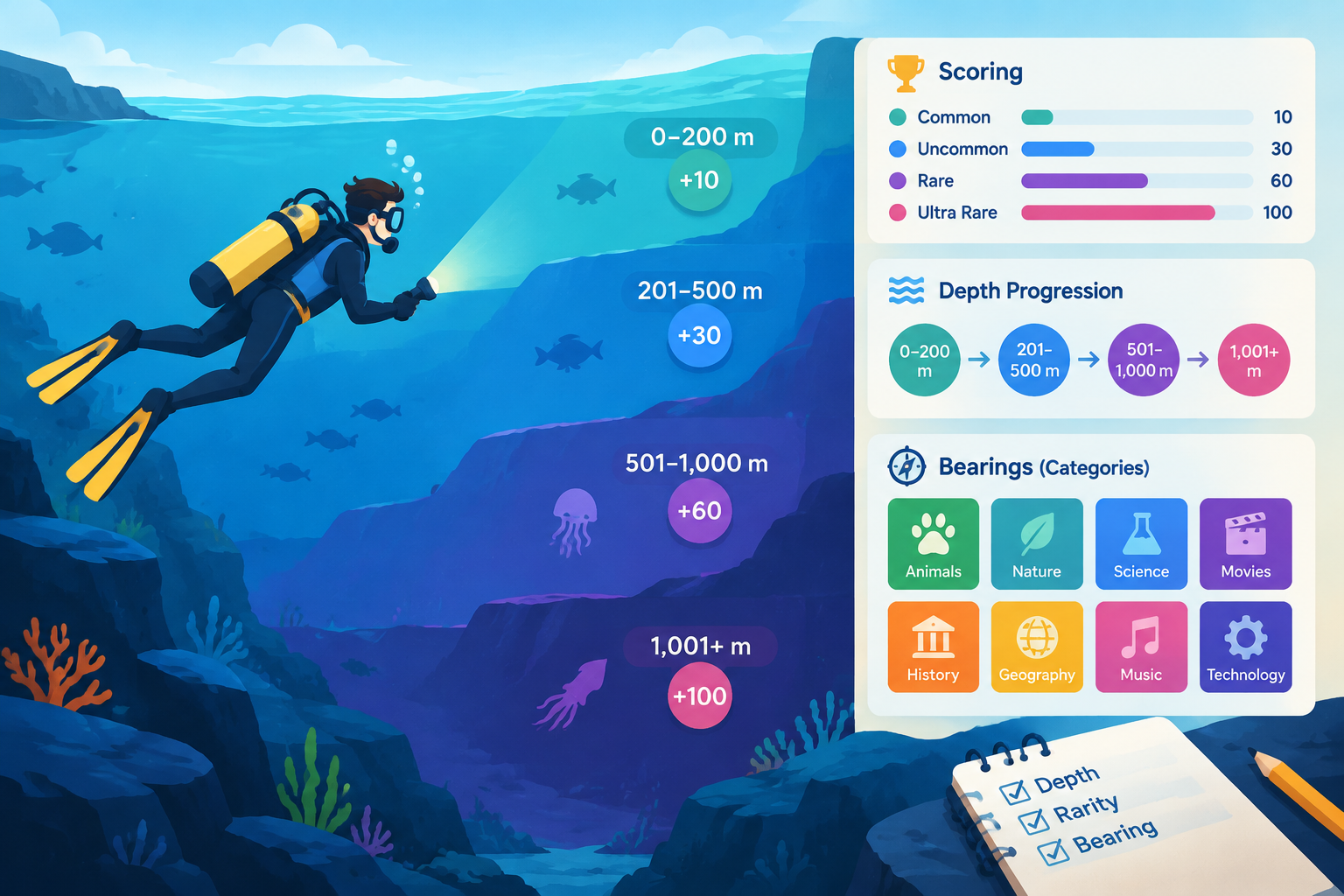
The Krillion Score Calculator is a player-focused tool designed to help Krillion players understand possible scoring outcomes and organize what they know about a run. Instead of treating every result as a mystery number, a calculator gives players a structured way to examine factors such as answer rarity, depth progression, and bearing tiers.
Krillion is a rare-answer trivia game where players explore unusual answers and compete through scoring systems built around discovery and knowledge. Because scoring systems can contain multiple interacting elements, players often want a clearer explanation of how their results are created and how different choices may affect a final score.
This guide explains how to use the Krillion Score Calculator, what concepts like Krillion scoring, dive depth, and bearing tiers mean in the context of player analysis, and which ideas are confirmed mechanics versus community theories.
A score calculator is a tool that helps players estimate, compare, or analyze results by entering known information. In Krillion, the calculator is useful for players who want to study patterns rather than simply view a final score.
Typical uses include:
The calculator is not a replacement for playing the game. It is a learning tool that helps turn individual results into useful information.
Players who are still learning the basics can also explore the broader Krillion answer library to review discovered answers and understand the types of knowledge the game rewards.
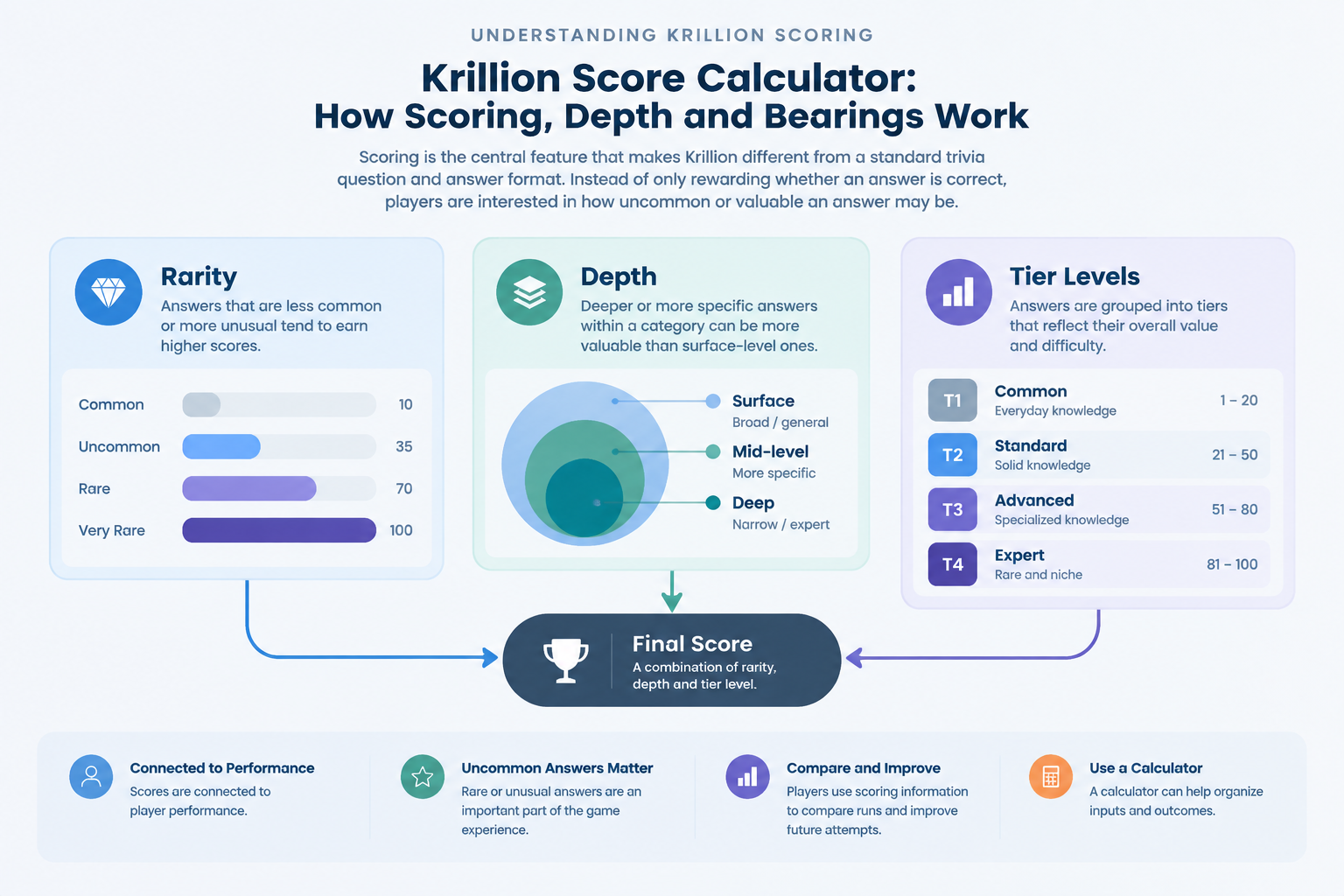
Scoring is the central feature that makes Krillion different from a standard trivia question-and-answer format. Instead of only rewarding whether an answer is correct, players are interested in how uncommon or valuable an answer may be.
The most reliable way to discuss Krillion scoring is to focus on concepts directly supported by available game information and player-facing tools:
The exact formula behind a score should be treated carefully unless officially documented. Community discussions may identify patterns, but observed patterns are not always the same as confirmed rules.
Rare-answer trivia games often create a different type of challenge from traditional quizzes. A common answer may demonstrate basic knowledge, while a less expected answer may demonstrate deeper research or broader awareness.
For Krillion players, scoring analysis often focuses on questions like:
The calculator helps players examine those questions in a consistent format.
Dive depth is one of the concepts players discuss when analyzing Krillion results. The idea is that progression through different levels or stages can provide additional context about a player's performance.
A deeper dive generally represents a further point of exploration within the game experience. Players often use depth as a way to describe how far they progressed before completing a challenge or reaching an outcome.
When reviewing dive depth, consider it as one measurement among several rather than a guaranteed explanation for every score.
For example, two players might reach similar depth levels but have different results because their answers, categories, or other scoring factors differ. Depth can provide useful context, but it should be considered alongside the rest of the available information.
A practical workflow is:
This approach prevents players from overreacting to a single result.
Bearing tiers are another term used by players when discussing progression and scoring structure. In general, tiers describe levels or categories that help organize performance.
Because community terminology can develop faster than official documentation, players should separate confirmed information from interpretation.
Verified mechanics:
Community strategy and interpretation:
Community strategies can be valuable for experimentation, but they should be treated as hypotheses rather than official rules unless confirmed by reliable sources.
A good calculator workflow is simple: collect information, enter the details, and review the result.
Before using the tool, collect the information available from your run. Depending on the calculator version, this may include score-related details, depth information, or tier information.
Keeping a record of previous games can make comparisons easier. A single result shows what happened once, but a collection of results can reveal trends.
One of the most useful calculator features is comparison. Players can examine how changing one factor might affect an outcome.
For example, a player might compare:
The purpose is not to guarantee a future result. The purpose is to understand possible relationships.
Every player approaches trivia differently. Some players focus on broad knowledge, while others specialize in researching unusual topics.
Keeping notes can help answer questions such as:
Over time, the calculator becomes part of a larger learning process.
Many players make the same mistakes when trying to understand scoring systems.
A single high or low score does not always reveal the complete system. Games with multiple scoring factors can produce different outcomes from similar situations.
Player communities are valuable sources of experimentation, but theories should remain labeled as theories. A strategy that works for one player may not apply universally.
Tools are useful, but Krillion is built around curiosity. Spending too much time optimizing every decision can remove some of the excitement of finding unexpected answers.

The best improvement strategies usually combine knowledge building with careful review.
Rare-answer games reward connections between different subjects. Reading widely across history, science, culture, geography, and entertainment can create more opportunities for unexpected discoveries.
The answer library can help players revisit discoveries and recognize patterns in the types of answers that appear.
A calculator should support decision-making, not replace it. The strongest players use tools to understand the game while continuing to develop their own knowledge and instincts.
The calculator is a fan-made utility provided as part of the Krillion Wiki experience. Krillion Wiki is an independent community resource and is not affiliated with or endorsed by the creators of Krillion.
No. A calculator can help players analyze information and compare possibilities, but it cannot guarantee a particular outcome. Results depend on the game situation and the information available.
Players may discuss scoring patterns and possible formulas, but any mechanic should be considered confirmed only when supported by reliable information from the game or its creators.
Improvement comes from a combination of learning, reviewing previous attempts, and understanding how scoring concepts work. Using tools like the calculator can make that review process more organized.
Rare answers are an important part of Krillion's identity, but successful play also involves understanding context, categories, and available information. A balanced approach is usually more useful than chasing rarity alone.
The Krillion Score Calculator gives players a clearer way to examine their progress, compare outcomes, and learn from each attempt. Whether you are exploring depth concepts, studying bearing tiers, or simply trying to understand your score, structured analysis can make each game more informative.
Try the Krillion Score Calculator and use your results as a guide for improving your next dive.
A few steps and you have your answer.
After the reveal, select the point value the game awarded for each of the seven prompts.
The calculator adds your picks, converts them to dive depth (× 10 metres) and names your bearing.
Copy the result line to share with friends or log your streak against your personal best.
Short, factual answers about Krillion — verified against sources before publishing.
Plankton is worth 10 points, Too Clever 15, Schooler 30, Rare 60, Deep Cut 85 and One in a Krillion 100. A missed or rejected answer scores zero.
Dive depth is simply your total score multiplied by 10. A perfect 700-point dive reaches 7,000 metres.
No. The official percentile depends on the day's player results, so the tool estimates only your score, depth and bearing from the fixed point values.
No. The calculator is free, needs no account, and runs entirely in your browser.
Read the scoring guide